Case study · Expedition Cruising
A faster, mobile-first booking experience for expedition guests
How National Digital gave Coral Expeditions a faster, more flexible online booking experience for guests planning an expedition cruise.
First published , last updated

At a glance
- Industry
- Expedition Cruising
- Engagement type
- Booking experience rebuild
- First release
- 2025
- Team
- National Digital engineering team
- Technology
- Next.js, TypeScript, AWS, GraphQL, Playwright
The booking experience at a glance
3 (Coral Expeditions, n.d.)
Ships booking through the experience
Every departure point
Departure points served
Every step
Booking journey covered end to end
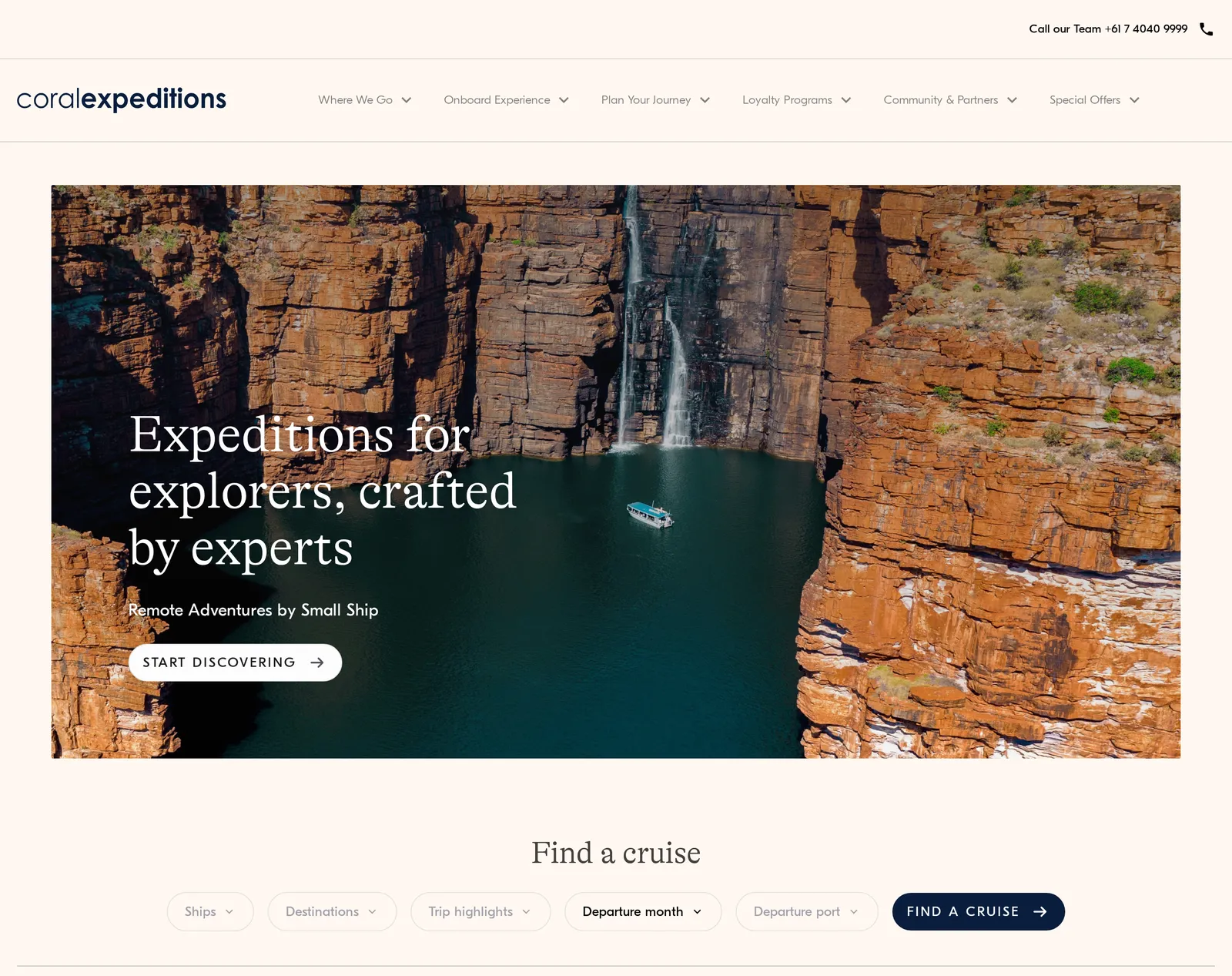
The challenge
Coral Expeditions wanted an online booking experience that matched the quality of its voyages - quick to load, clear on mobile, and able to change as itineraries and campaigns change without waiting on everything sitting behind it.
What we built
A rebuilt Next.js booking site served by a clean, National Digital-built API layer, so the guest experience can be designed, measured and improved on its own release cycle.
- Next.js booking front end rebuilt mobile-first for speed
- Typed, documented APIs serving the guest-facing site
- Caching to keep peak-season browsing fast
- Automated end-to-end tests across the full booking journey
What we built in each area
Website
A Next.js booking front end, built mobile-first, serves the guest-facing site.
- Next.js
- TypeScript
- AWS
Integration layer
Typed, documented APIs built by National Digital serve the guest-facing site.
- GraphQL
Bookings & operations
An automated end-to-end test suite covers the full booking journey.
- Playwright
The outcome
Coral Expeditions now has a booking experience it can shape on its own timetable. The guest-facing site is a product in its own right - fast, mobile-first, and covered end to end by automated tests - so improving how a voyage is presented, priced or selected is a front-end decision that touches no other part of the platform.
Where it went next
The same foundation gives Coral Expeditions room to keep extending the guest experience - richer itinerary and cabin content, and more of the planning journey handled online.
This case study describes real work delivered by National Digital for Coral Expeditions.
Key Takeaways
What a faster booking experience actually takes
- A booking journey is a product, and it earns its own release cycle.Critical
Giving the guest-facing site its own service layer means the booking journey can be redesigned, measured and improved on its own timetable, instead of every change being scheduled around everything else the business runs.
- When the purchase is considered, page speed is part of the offer.Critical
An expedition cruise is researched over weeks and compared across many visits. A site that loads quickly and presents itineraries clearly keeps people in the planning journey, which is where the decision actually gets made.
- Design the booking flow for a phone first, then let it grow up.Important
Most travel planning starts on a phone and finishes somewhere else. Building the flow mobile-first means the narrow case is the designed case, and the desktop experience gets the room it has anyway.
- Clean API contracts let the experience and the systems behind it move separately.Important
The front end talks to documented, typed contracts and never reaches into whatever sits behind them. Either side can change on its own schedule as long as the contract holds, which is what keeps a guest-facing rebuild from becoming a whole-of-business project.
- End-to-end coverage is what protects a multi-step transaction.Helpful
Automated tests exercise the real booking journey instead of isolated units, because typed contracts prove the pieces agree with each other but not that the flow still makes sense to the person completing it.
Coral Expeditions' booking experience is a fast, mobile-first product with its own release cycle, served by clean API contracts and covered end to end by automated tests. The guest journey can now be improved continuously without that becoming a whole-of-business project.
Questions decision-makers ask about this build
What changed for guests booking a voyage?
The booking experience got faster and clearer, particularly on a phone. Itineraries, cabins and pricing are presented through a rebuilt Next.js front end designed mobile-first, and the whole journey - from browsing a voyage to confirming a booking - is covered by automated tests so it stays that way as the site keeps changing.
Why rebuild the booking experience rather than restyle it?
Because a restyle leaves the constraint in place. The thing slowing the guest journey down was not how it looked, it was that the site could not change on its own timetable. Giving the front end its own service layer and clean API contracts is what makes continuous improvement a front-end decision instead of a scheduling negotiation.
How do you keep a booking site fast during a campaign?
Expedition cruise demand is peaky: campaigns, season launches and departure dates concentrate traffic into short windows. The APIs serving the site scale per service rather than sitting on provisioned capacity between those peaks, and caching absorbs repeat reads so a busy week is served quickly rather than becoming load on everything behind it.
How is a multi-step booking flow tested?
End to end. The booking flow is covered by Playwright tests that exercise the real journey rather than isolated units, which matters when the whole value of the experience is a multi-step transaction that must not break. Typed contracts catch drift between services; the end-to-end suite catches a flow that has stopped making sense to a human being.
Can the experience keep changing after launch?
That is the point of the design. Presentation, pricing clarity, cabin selection and itinerary detail all live in the front end, behind documented contracts. Coral Expeditions can improve any of them and release on its own cadence, with the automated suite standing behind each change rather than a manual regression pass.
What does this approach suit beyond cruise bookings?
Any business whose customer experience is a considered, multi-step purchase served from systems that run the rest of the business - travel, events, hospitality, education, healthcare scheduling. The move is the same: give the customer-facing product its own clean contracts and its own release cycle, so it can improve at the pace the market expects.
More client work
Property Management & Short Stays
Luxico: One Property Management Platform
What's next
Rebuilding a booking experience?
Coral Expeditions' guest journey runs as a product in its own right, on clean contracts it can keep improving. If you're weighing the same move, see how we approach custom booking and scheduling systems and connecting the systems behind them, part of our wider custom software development work.
References
- Coral Expeditions. (n.d.). Fleet. Coral Expeditions website. https://www.coralexpeditions.com/fleet
Who stands behind this page
- Registered business
- General Consulting Services Pty Ltd as trustee for the Australian Business Trust, trading as National Digital. ABN 13 744 838 758.
- In business
- National Digital has shipped production platforms since 2016. About National Digital
- Client reviews
- National Digital has 14 Google reviews with an average rating of 5.0 out of 5, read on 9 November 2026. Its Upwork profile shows 42 reviews with an average rating of 5.0 out of 5. Its Clutch profile shows 1 review with a rating of 5.0 out of 5. A person checked the Upwork and Clutch figures on 7 November 2026. How the figures are counted National Digital on Google Maps National Digital on Upwork National Digital on Clutch
Want a platform like this for your business?
Tell us what you're building. We'll come back within one business day with what we'd do first and what it would take.